The Assets area is where you manage and work with digital assets such as images, documents, audio files, spreadsheets, and templates.
It is used by multiple audiences:
- CMS and PIM editors for daily file work (upload, organize, search, download, basic editing)
- Implementers and administrators for template/design assets, permissions, and governance
- Developers and integrators for understanding technical limits and behavior

Use the tree to select where you work.
Root sections and permissions
The Assets tree is grouped into three sections, each with a different purpose:
- Media: regular content folders under
/Filesexcept system folders. This is where editors usually work. - System: includes system-level folders (
/Files/System,/Files/Cache.net,/Files/Templates) used for platform and implementation concerns. - Design: design folders under
/Templates/Designsused for template and static design assets.
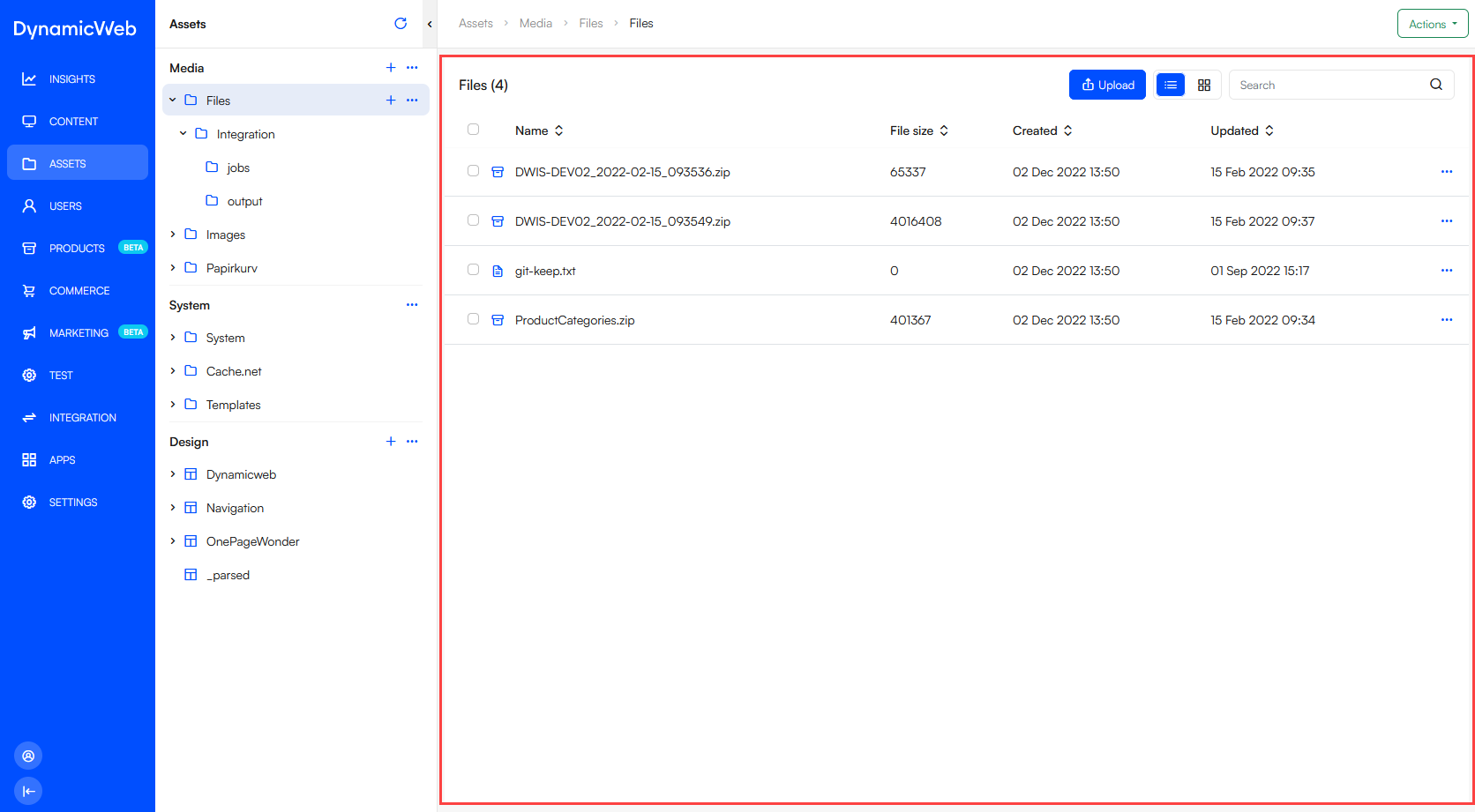
When you click a folder, files and folders are shown in the workspace:
What any given user can see and do under each section depends on the permissions defined for the user or user group. Since the System- and Design-sections contain solution-critical files, we recommend that you set up permission to limit editor-access to them:
- Use Media for business content files and images maintained by editors
- Restrict System and Design to implementers/admins unless there is a clear editorial need
- Use folder-level permissions to separate responsibilities across teams
In practice:
- Read permission enables browsing, search, and download
- Create permission enables upload, new file, and new folder
- Edit permission enables rename and text editing
- Delete permission enables delete and move operations
For permission concepts and role setup, see the permissions article.
Common tasks for editors
A number of common tasks are often handled by editors using the Assets area - for example:
- Uploading files
- Searching for assets
- Organizing files and folders
- Downloading files and folders
- Editing text-based files
- Working with images
They are described below.
Upload files
Use Upload in a folder context to upload one or more files.
Typical flow:
- Open a target folder.
- Click Upload.
- Drag and drop files or select files from disk.

It is possible to control which extensions are allowed/disallowed via the File manager settings.
Search assets and go to location
Use Search from a folder to run recursive search in that branch. When a result is shown from recursive search, you can use Go to file location to jump to the actual folder.
Organize files and folders
From list and context menus you can:
- Create New file and New subfolder
- Rename files and folders
- Copy and Move files/folders
- Delete files/folders
You can also run bulk actions from the list context (for selected items), including copy, move, delete, and download.
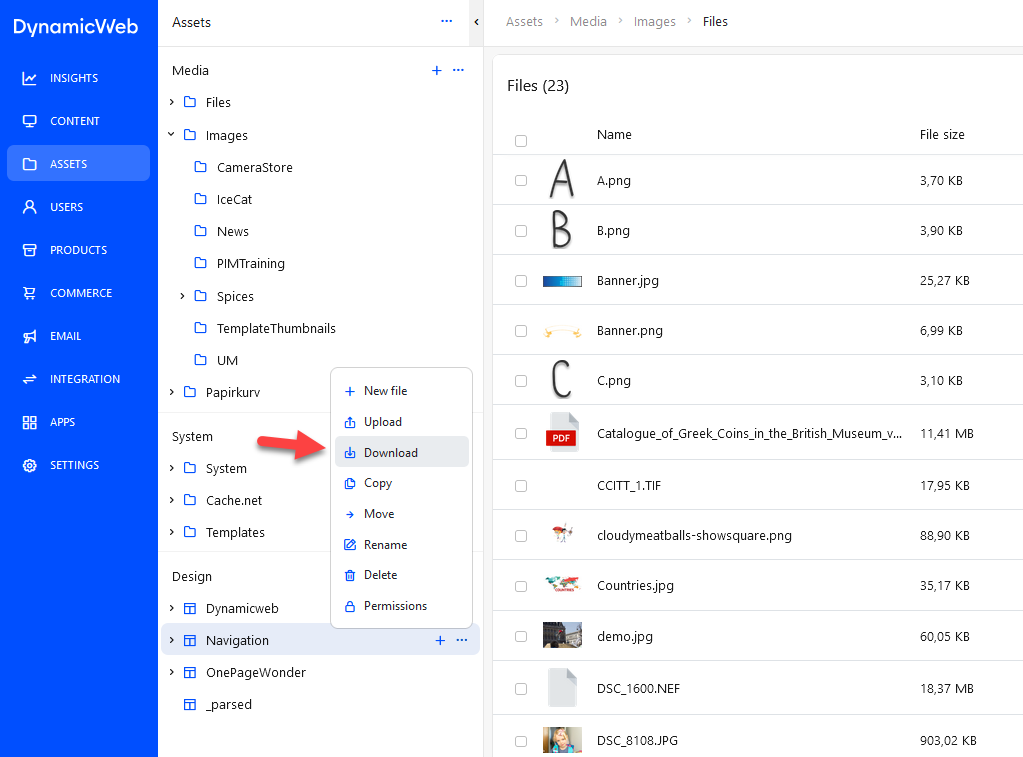
Download files and folders
You can download:
- A single file
- Multiple selected files (downloaded as zip)
- A full folder (downloaded as zip)
Edit text-based files
For editable text-based file types, Edit / Edit as text opens the built-in file editor:

Work with images
Image files have an image overview with file details and preview. For supported formats, you can also crop images using Crop.
Important behavior:
- SVG files are not croppable in the image crop flow.
- Cropping creates a generated image output according to the image editor behavior.