Open this node to see a list of all existing shipping methods on the solution - on this test solutions that's a lot:
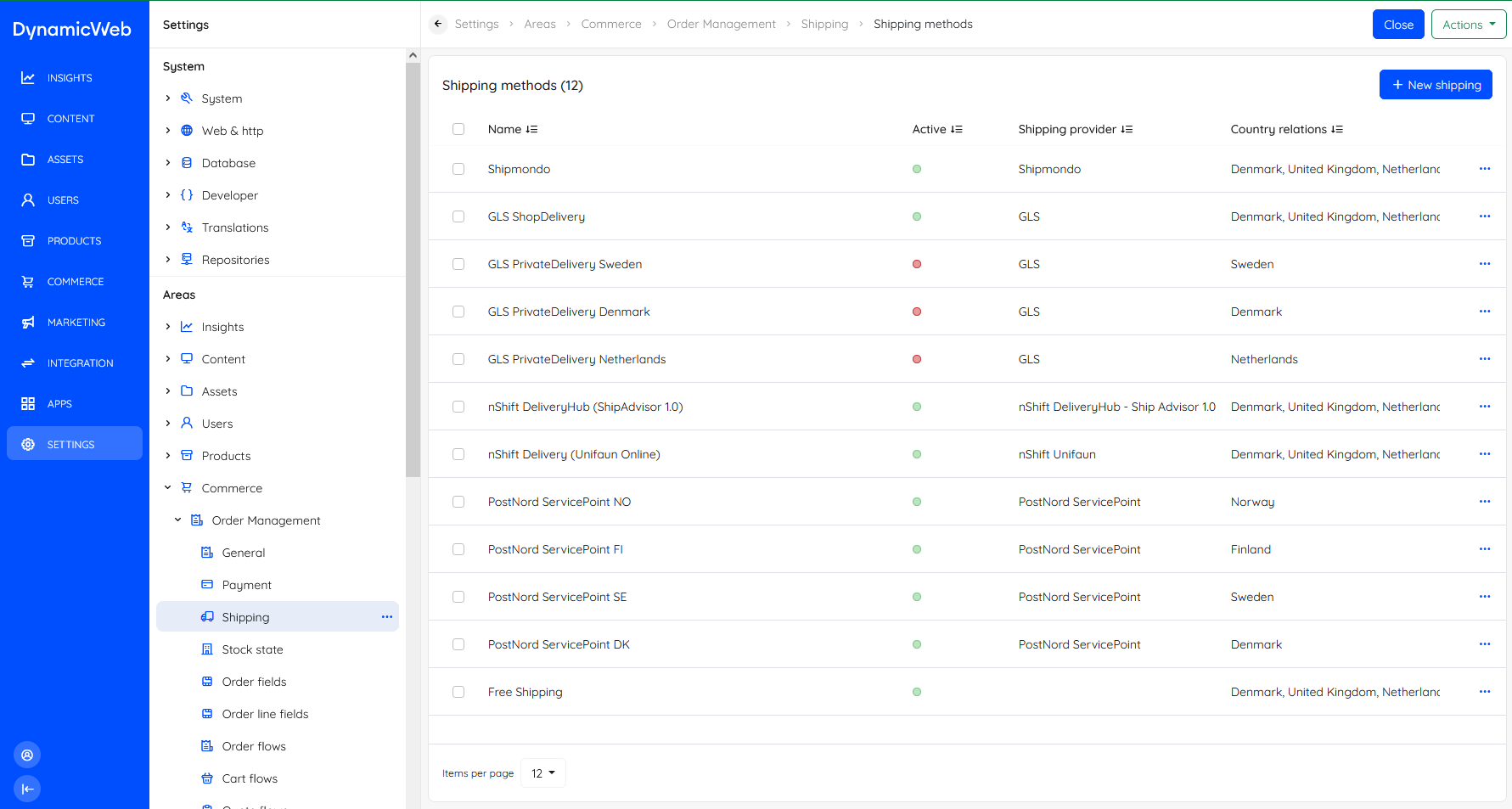 For each payment method you can see:
As is true for all lists, you can click each list item to view more details about how each shipping method is set up.
You can read more about the settings on each shipping method tab in the following sections.
The General tab contains the following settings:
| Setting |
Used for |
Notes |
| Name |
Set the name of the shipping method |
Also used in frontend |
| Active |
Activate/deactivate a shipping method |
|
| Description |
Describe the shipping method |
|
The Provider tab is used to select a shipping provider - an integration to an external delivery service like GLS or Shipmondo. Note that you must add these providers to your solution via the appstore before you can select them.

Each shipping provider comes with a set of parameters relevant to the external service – where you must provide e.g. an API key, a service URL, and so on, depending on the requirements of the external service. Each shipping provider is documented separately.
The Fees tab is a matrix which lets you create rules for assigning shipping fees to orders. A rule takes various parameters – like weight, user, product group, etc. – and if the order matches the criteria the fee is added to the order according to the fee settings.
When creating a shipping method you have the following fee settings possible:
| Settings |
Used for |
Notes |
| Default fee |
Set the default fee |
This will be the fee if the provider selected below doesn't return a value |
| No fee for purchases over |
Set an amount for when no fee is applied |
If an order is over this amount, the provider will not be asked to calculate a fee |
| Base free shipping calculation on price with VAT |
|
|
| Base free shipping calculation on discounted price instead of original price |
|
Check to base the No fee for purchases over calculation on the discounted price |
| Eligible for free shipping |
|
This shipping method can be selected when an [amount discount with free shipping](xref: manual-discounts) is applied |
You further have fee rule settings:
| Settings |
Used for |
| Use custom fee rules |
Activate the fee rules created in DW |
| Use fee rules from provider |
Deactivate the fee rules created in DW |
| Both weight and volume must apply |
Both weight and volume must apply for a rule to trigger |
| Either weight or volume must apply |
Either weight and volume is enough for a rule to trigger |
| Use highest applicable fee |
Set fee priority |
| Use lowest applicable fee |
Set fee priority |
To create a fee rule:
- Go to Settings > Commerce > Order Management > Shipping
- Click on an already made shipping method and go to the Fees tab
- Click the '+ New fee rule' button and configure the fee rule:
- Provide a name, set the rule to active by checking of 'State'
- Specify when the rule is valid from (date included) and valid to (date excluded). If no dates are selected, the rule will always be valid
- Specify a fee – and a fee type (fixed or percentage), as well as any weight and volume limits – e.g. 5% for orders below 10”x10”x10” under 10lb
- Select for which users, user groups or customer number the rule applies to
- Select for what shops, products or product groups the rule applies to
- Select if the rule applies to orders above a certain total price, or in a particular order context, country/region, currency or zip code
You need only create the rules relevant for your shipping setup – so in reality, you won’t need to use all the options in the rules window but only those relevant for your setup.

Countries is used to specify the delivery countries for which this shipping method should be available. In the shopping cart, only the delivery methods available for the country set on the billing address of the user checking out are shown.
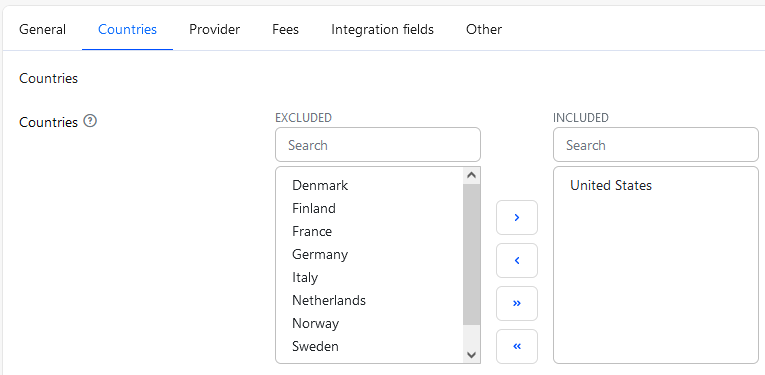
If you include states or regions within a commerce country, they will also appear as selectable options here.
Frontend groups is used to specify which groups the shipping provider is available for.

Products and Groups is used to specify how product and product groups affect which shipping methods are available.

- Disable: No filtering
- Inclusive: The shipping provider is only available with the specified items.
- For example, if “Heavy Delivery Service” is set to inclusive for product group “Heavy machinery”, then “Heavy Delivery Service” is only available when an item from “Heavy Machinery” is in the cart.
- Exclusive: The shipping provider is not available with the specified items
- For example, if “Standard Parcel Service” is set to exclusive for the product group “Fragile Items,” then “Standard Parcel Service” is not available when an item from “Fragile Items” is in the cart.
Weight limits is used to specify how minimum/maximum order weight affect the shipping method available, e.g. remove a specific shipping method if product is over or under the weight limit.

The Business Central tab is used to specify for which user groups the shipping is available for in frontend, this is particularly useful if different shipping methods should be available for B2C and B2B customers. It is also where you can give the shipping method an icon, and where you find the Business Central integration fields.
The Business Central integration fields can be used to match a shipping method with a shipping method in an integrated Dynamics Business Central environment.
The following Business Central integration fields are available and their corresponding Business Central Standard fields:
| Settings |
Used for |
| Code |
Corresponds to ShippingCode, the ID in the ERP |
| Agent Code |
Corresponds to ShippingAgentCode, the ID in the ERP |
| Agent Name |
Corresponds to ShippingAgentName |
| Agent Service Code |
Corresponds to ShippingAgentServiceCode, the ID in the ERP |
| Agent Service Description |
Corresponds to ShippingAgentServiceDescription |
When an Agent or Agent service code is added to a payment method, the live integration will check if a matching code exists in the ERP before including the fields in the salesheader. The ERP will then add the context specific information to the response XML generated in the codeunit.