DynamicWeb 10 supports the localization & translation of products and related content into all the ecommerce languages created on a solution. This is typically used for solutions where you want to create localized versions of the product catalog for different markets.

In the Ecommerce-settings of a website you can then select which language version is shown in frontend by default.
Two important things to note:
- Products and product groups must be translated in order to be available on non-default languages
- All other related features - e.g. variant groups, asset categories, etc. - will fallback to the default language is no translation exists
Products
Language versions of a product are created and removed using the Add languages and Remove language options in the action menu when in product list or product details view.
To create a language version of one or more products yo:
- Select the product(s)
- Use the action menu to select Add languages
- Select the languages you want to add
- Select a state for the new languages
- Click Save:

To remove a language version again you select the product(s), use the action menu to select Remove language, select the language you want to remove, and then click Save:

You can only remove one language version at the time - and never a master product in the default ecommerce language.
Once a language version has been created, you can use the Translations-button in a product edit view to translate product field values:

Which fields can be edited and which are locked to the master value is controlled using the field visibility settings for each field. If relevant, you can also use grid edit to edit languages version fields.
Product groups
Like products, product groups must be translated to an ecommerce language to be available in frontend. To translate a product group you open the edit-view of the group and then use the action menu to select Manage languages, then select the languages you want to create language versions for, then Create:

You can remove language versions of a product group by using another one of the Manage languages options:

As for products, you use the Translations-button to view and translate product group field values:

You can get a quick overview of which product groups are translated to which ecommerce languages via the Languages option on the channel context menu:

Other ecommerce content
It is also possible to localize other ecommerce-related content - e.g. country names, attribute labels, list box options, and so on - but it is not strictly necessary for the system to work, as it will fall back to using the default language if no translations exist.
To translate one of these objects:
- Open the edit-view of the object
- Use the Translations button to select the languages to translate them into
- Use the side-by-side view to translate the object
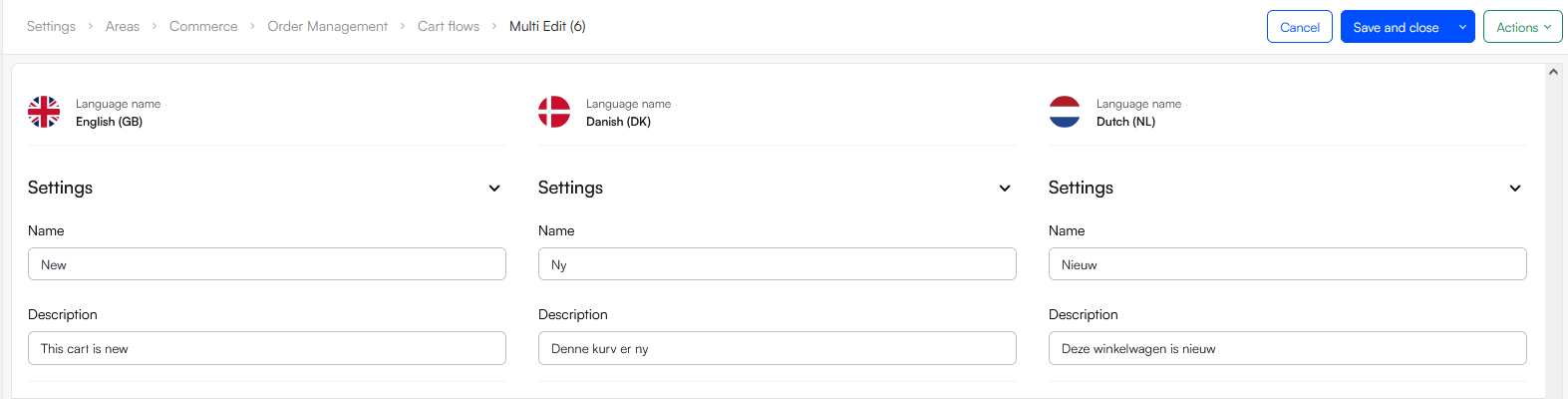
The following products-related features can be translated:
- Countries
- Currencies
- VAT Groups
- Standard fields
- Global custom fields
- Attribute group fields
- Variant Group options
- Relation groups
- Product units
- Asset categories
The following commerce-related features can be translated: